
SiteLang Guide
AI Translation for WordPress: How It Works, Costs and Quality Checks
Automation with oversight
Understand the workflow, estimate the full cost, and decide what to review before publishing AI-assisted translations.
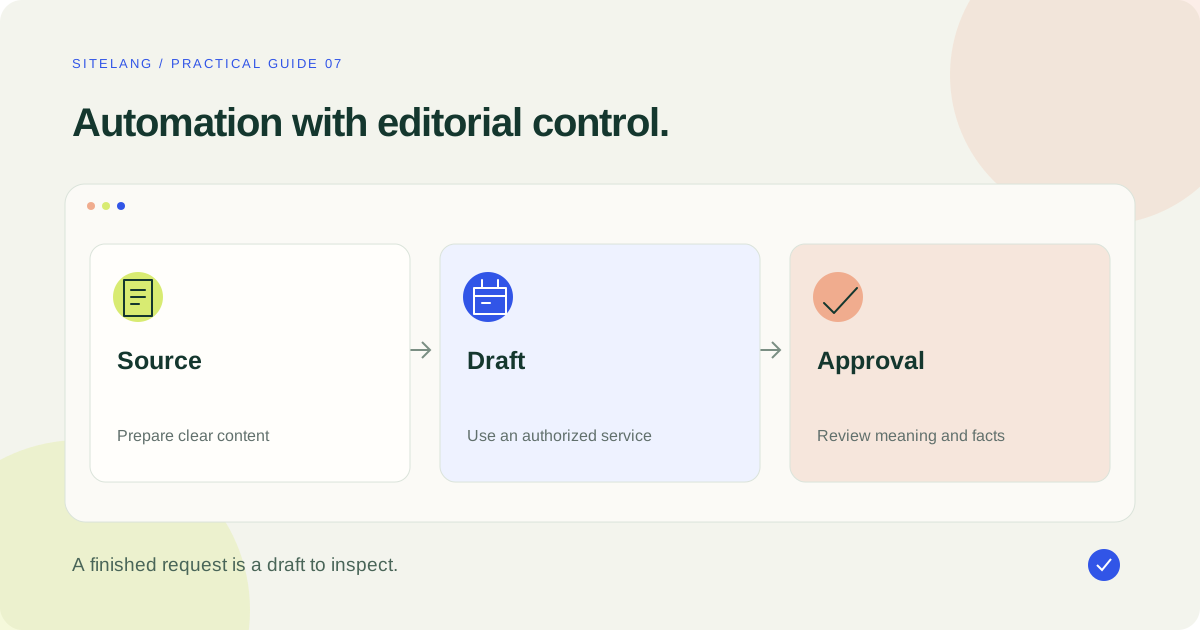
AI translation can produce a useful first draft for WordPress content, but quality depends on the source, context, protected structure, and review process. Budget software access, usage, retries, and human review separately. Tokens, words, and vendor credits are not interchangeable units.
- Measure a representative pilot before budgeting the full site.
- Separate provider usage examples from a plugin’s actual retail price.
- Review meaning, product facts, markup, and navigation before publication.
What AI translation for WordPress actually involves
AI translation for WordPress is a workflow, not just a button. The system selects source fields, sends an authorized request to a translation provider or managed service, receives a result, and places that result into a review or publication process. What is stored and when it becomes public depend on the product.
A useful implementation must do more than return fluent sentences. It needs to preserve relationships between content records, protect markup and placeholders, and give the editor a way to check the result. It should also explain the data flow and the conditions under which a request consumes an allowance.
Begin with a small content sample. Include an ordinary paragraph, a structured page, a product if relevant, and a piece containing important terminology. The sample reveals practical issues that a short promotional demonstration may never encounter.
Choose where automation belongs in your process
Manual translation works when a capable writer can produce and maintain the content. Machine or AI assistance can accelerate drafting. Professional or knowledgeable human review helps where the meaning matters most. These are choices about responsibility as well as speed.
| Approach | Useful situation | Responsibility that remains |
|---|---|---|
| Manual translation | Small volume and a qualified writer | Consistency, completeness, and future updates |
| AI first draft | Large volume with an available reviewer | Meaning, facts, terminology, and page behavior |
| AI plus targeted expert review | Specialist or high-impact content | Appropriate expertise and final approval |
| Professional translation | Content needing a dedicated language process | Briefing, integration, and ongoing maintenance |
Decide which content can follow a light review and which needs detailed attention. A temporary blog introduction and a purchase instruction do not carry the same consequence if a phrase is wrong. Use a risk-based editorial priority rather than reviewing only the pages that are easiest to open.
Keep the source clear. Remove ambiguity, contradictory statements, stale information, and unnecessary jargon before translating. Automation can reproduce a source problem in every target language; it cannot determine the correct business fact on its own.
Understand the units before comparing costs
A word allowance counts something different from a token allowance. Tokens are units used by a model’s text processing and can vary with language and content. A vendor credit may represent another internal billing rule. Do not convert these units using a universal promise such as “one token equals one word.”
Clarify whether the plan counts source words, translated words across languages, input tokens, output tokens, or particular operations. Ask what happens with instructions, markup, repeated requests, changed source content, and polishing passes. A recurring subscription and a one-time usage balance can also behave differently.
Some services meter the amount of published translated content rather than renewing the entire word capacity every month. Other products combine an annual license with a separate AI allowance. Read the actual plan definition before dividing a monthly fee by the number printed on a comparison card.
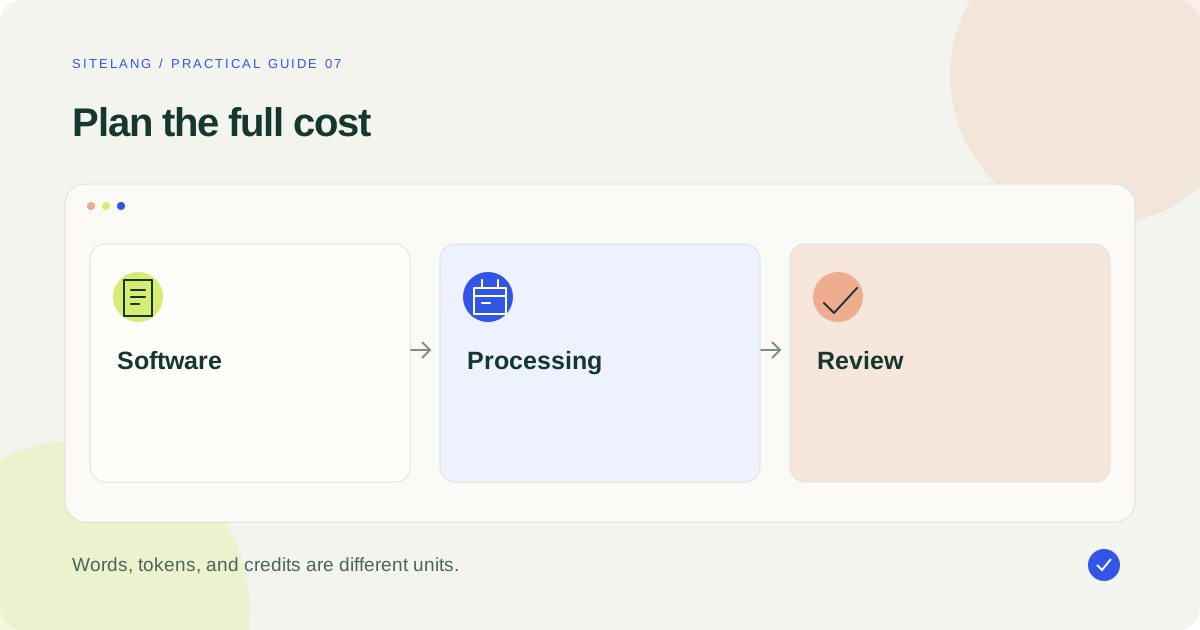
Build a transparent hypothetical estimate
Consider a planning example with 100 pages averaging 500 source words and two target languages. That gives 50,000 source words and 100,000 target-language word equivalents to prepare. It does not tell us the exact token count.
For illustration only, assume a measured pilot suggests 250,000 input tokens and 300,000 output tokens for the intended processing. Also assume fictional rates of $2 per million input tokens and $8 per million output tokens. These are not current provider rates, a SiteLang quote, or a claim about your pages.
| Component | Calculation | Illustrative amount |
|---|---|---|
| Input processing | 250,000 ÷ 1,000,000 × $2 | $0.50 |
| Output processing | 300,000 ÷ 1,000,000 × $8 | $2.40 |
| Raw subtotal | $0.50 + $2.40 | $2.90 |
| Illustrative 20% processing reserve | $2.90 × 20% | $0.58 |
| Raw total with reserve | $2.90 + $0.58 | $3.48 |
This deliberately simplified calculation excludes the plugin license, managed-service pricing, hosting, taxes, and reviewer time. If your service charges by a plan allowance, do not treat the raw-provider total as the amount you will pay.
Build a second line for review. If a pilot takes an editor several minutes per page, multiply that observed review time by the planned scope. The editor’s work can be the dominant budget item even when raw machine processing is inexpensive.
Compare actual billing models fairly
TranslatePress’s pricing presents annually billed plans with AI word allocations. Weglot’s pricing describes plan-specific translated-word capacity. Polylang’s comparison identifies a DeepL integration requiring the customer’s own key for the applicable feature. Those arrangements should not be ranked by treating every printed allowance as the same unit.
For SiteLang, the public release distinguishes included local tools from Growth/Pro managed AI service allowances. Use the current catalog available through the documented License flow and the actual purchasing terms. The attached marketing design is a visual reference, not proof of today’s price, quota, or renewal arrangement.
Ask whether remaining usage rolls over, which actions consume the allowance, whether failures can be charged, and what happens when the account disconnects. If a policy is not documented, get a clear answer before planning a large batch.
Use SiteLang’s connection and draft workflow deliberately
In the inspected release, managed requests go through SiteLang’s service, with provider credentials retained on the server. Local manual tools do not require that connection. This distinction is useful when choosing which content to send through automation.
Connect through SiteLang → License only after reviewing the service disclosure. Confirm eligible access, select the appropriate target language and content, and start with a limited sample. Keep the original record and review the translated output in context.
Product translations remain drafts for review in the documented workflow. Other automatic publishing behavior should be checked in your installed version before submitting a large page batch. If your process requires every result to remain private until approval, validate that requirement on staging rather than assume all content types share the same default.
The bulk product guide explains how to turn a successful sample into controlled catalog batches without repeatedly submitting everything.
Review meaning before polishing the style
A fluent paragraph can still reverse a condition, omit an exception, or change a specification. Review the meaning first. Compare what a reader is being told to do, who the sentence refers to, and whether a qualification or negation survived.
Then review terminology. Decide how brand names, product types, specialist terms, and repeated interface phrases should appear. Keep an approved terminology list even when the tool does not provide a dedicated glossary feature. A shared editorial reference is still useful outside software.
| Area | Question | Record |
|---|---|---|
| Meaning | Is the instruction or claim equivalent? | Approve or correct |
| Facts | Are measurements, dates, prices, and exclusions intact? | Verify against the source owner |
| Terminology | Are repeated terms consistent? | Update the terminology reference |
| Structure | Are variables, links, and markup preserved? | Inspect the rendered page |
| Reader fit | Does the wording sound natural and match the task? | Review with a qualified speaker |
Do not turn this rubric into an invented accuracy percentage. A checklist documents review work; it is not a scientifically measured benchmark.
Protect markup, placeholders, and data
Preserve machine-readable values such as product IDs, shortcode syntax, placeholder tokens, and URLs unless the workflow explicitly maps an intended replacement. Translate the visible label separately from the underlying identifier.
After processing structured content, inspect the actual rendered output. Check lists, buttons, links, dynamic fields, and reusable templates. A result that looks correct as plain text can still damage a layout or direct a reader to the wrong page.
Review the service’s privacy disclosures before submitting content. Identify the receiving service, provider, selected data, operational records, and relevant retention policies. Avoid assuming that local storage means no selected content ever leaves the server when a managed request is used.
Remove unnecessary personal information from a translation batch and use fictional data in demonstrations. Do not publish account keys, activation codes, private logs, customer addresses, or payment details in screenshots or source notes.
Create a reviewer brief and an exception policy
Give the reviewer the purpose of the page, the intended reader, approved terminology, and the facts that must be checked against the business source. Include the surrounding layout when a phrase appears in a button, form, or product option. Context reduces the chance of a fluent but unsuitable choice.
Define how uncertain cases are handled. A reviewer should be able to mark unclear source meaning, a missing specification, or an unsupported claim for clarification rather than invent a polished answer. Correcting the source can be more valuable than producing a second target-language draft.
Use a small set of approval states that your team understands: needs source clarification, needs language correction, needs technical correction, and approved. Keep these editorial states distinct from a software job’s processing status. They describe different kinds of work.
Decide what happens after source changes. Preserve a record of approved human corrections and inspect whether a retranslation would overwrite them. When only a delivery sentence changes, targeted review may be more appropriate than regenerating the entire page. A clear exception policy turns automation into a maintainable process rather than an expanding collection of drafts no one owns.
Roll out a repeatable review-and-update process
- Choose a representative pilot and declare its scope.
- Prepare the source and identify protected values.
- Measure actual usage and note any additional passes.
- Review meaning, facts, terminology, and structure.
- Open the result on desktop and mobile and follow key links.
- Resolve the pilot’s issues before processing a larger batch.
- Record who approves publication and future source changes.
Review search-related wording separately from grammatical quality. A good translation may still use terms your target audience does not search for. The multilingual SEO guide explains how content intent connects with technical page signals.
Use the plugin comparison when deciding which workflow fits your team. The most sustainable choice is the one you can inspect, budget, review, and maintain—not the one with the largest unexplained allowance.
Good questions. Clear answers.
Can AI translation be published without review?
That is a publishing decision, but a finished request is not proof of accuracy. Review important meaning, facts, protected structure, and the visitor’s next action.
How many words fit in a token allowance?
There is no universal conversion. Language, text structure, instructions, output, and additional processing affect usage. Measure a representative pilot.
Is a provider API estimate the same as the plugin price?
No. A managed product may include software, service operations, support, and a distinct pricing model. Use its actual terms rather than a raw-provider calculation.
What should be reviewed first?
Prioritize meaning and high-impact facts, then terminology, structure, and style. Purchase instructions and specialist claims deserve appropriate human expertise.
Sources & further reading
Sources checked 25 October 2026. Document-based guidance; your installation and integrations require their own tests.